OVERVIEW
Over four days, participants delved into the fundamentals of Oxford Nanopore Technologies (ONT) MinION sequencing. Beginning with an optional workshop on wet lab protocols, the course progressed through a theoretical introduction to ONT technology. Practical sessions covered specimen extraction, PCR, bead clean-up, adapter ligation, library preparation, and flowcell loading, and culminated in a MinION run. Laboratory work was a combination of demonstrations and hands-on activities. The course ended with a workshop on data handling using ONTOLOGY with class data.
Read below to know more about the MoU, COP17 and the potential of DSI to meet the KMGBF targets
AUDIENCE
The 14 participants had a wide range of backgrounds: MSc and PhD students, researchers, senior engineers and biodiversity consultants. Mostly students.
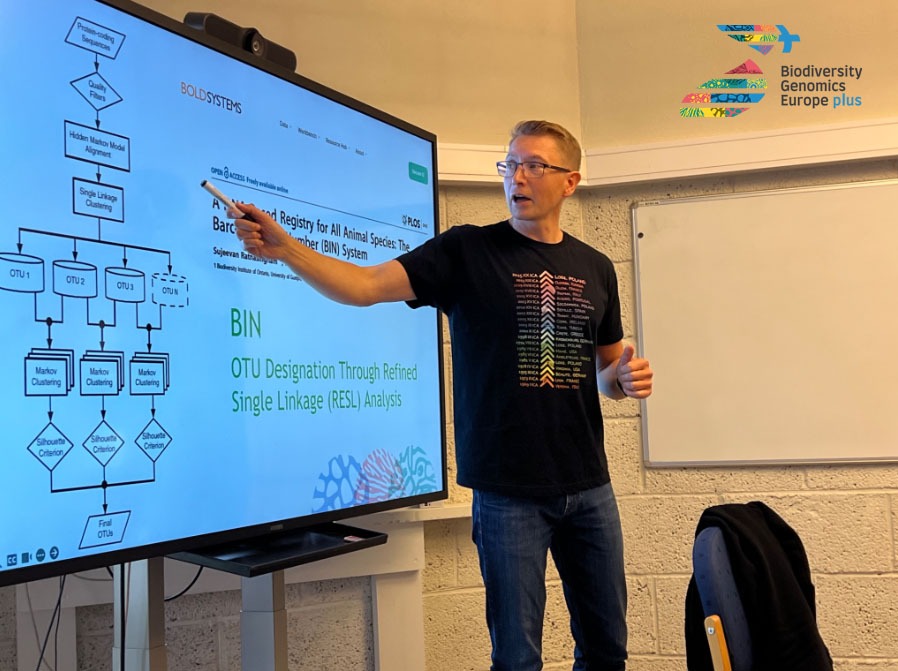
Tomasz Mamos from the University of Łodz lectures on how DNA barcodes can be used to generate species hypotheses.
PROGRAMME
Monday, 21 September: INTRODUCTION
10-12h OPTIONAL SESSION: Introduction to wetlab techniques.
13-17h Introduction to DNA barcoding and barcoding with Oxford Nanopore Technologies
Tuesday, 22 September: EXTRACTION & PCR
9-11h Extraction and PCR in the lab
14-17h Pooling, Clean-up and QC in the lab
Wednesday, 23 September: PREPARATION and SEQUENCING
9-17h Preparing for and starting the MinION sequencing run
Thursday, 24 September: DATA HANDLING
9-12h Retrieving and working with sequencing data
13-17h Working with taxonomic assignments in Sequence ID, BOLD, etc.
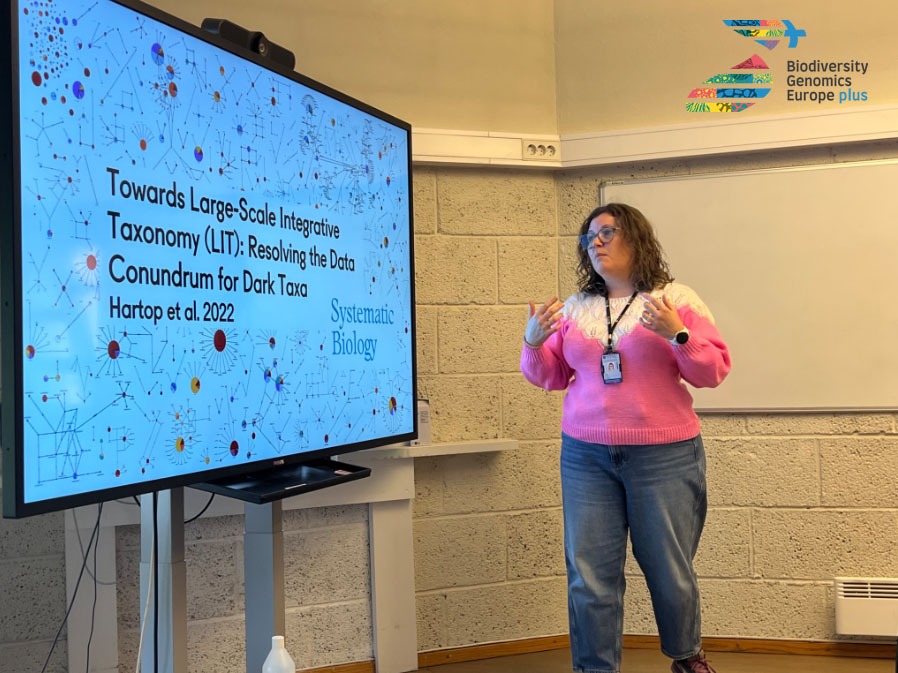
Emily Hartop from the NTNU University Museum lectures on DNA barcoding of Dark Taxa.
FEEDBACK
The feedback so far (gathered via evaluation forms) was very good to excellent on almost all metrics, but some would have liked more detailed information sent out before the course start.
“It is great to have the opportunity to gain hands-on experience with high-end equipment. It was also invaluable to get insights into real-world research directly from active researchers.”
Participant to the course