The three communities that conform BGE+ –iBOL Europe, ERGA and CETAF– will sign a Memorandum of Understanding in the next few days during the Conference of the Parties to the Convention on Biological Diversity, otherwise known as COP17. The MoU is certainly a milestone in the still short history of BGE’s endeavour, and the fact of signing it during COP17 is not just casual. BGE+ wants to send a message to the entire scientific community – digital sequence information on genetic resources (DSI) has crucial relevance to measure and address the Kunming-Montreal Global Biodiversity Framework targets.
Read below about the MoU, COP17 and the power of DSI to meet the KMGBF targets
Memorandum of understanding of iBOL Europe, ERGA and CETAF
iBOL Europe, ERGA and CETAF have signed a historic agreement with a fundamental purpose: to build a coordinated European research infrastructure for biodiversity genomics. The infrastructure will harness Europe’s extraordinary expertise in taxonomy, genomics, bioinformatics, biodiversity collections, and environmental monitoring, and enable experts to work at the necessary scale within a connected system of shared resources, technology, and data, beyond geographic and political limitations.
The COP17 in Yerevan (Armenia)
The conference COP17 (Yerevan, Armenia, 19–30 October 2026) will allow for the first global review of collective progress in implementing the Kunming–Montreal Global Biodiversity Framework (KMGBF) for reversing global biodiversity loss by 2030. Institutions, governments, organisations and specialists worldwide will gather at COP17 to monitor progress on specific targets, identify remaining gaps, and consider how implementation can be accelerated to ensure that the GBF’s ambition remains within reach.
Why has BGE+ chosen COP17 to sign its MoU?
For a very straightforward reason. We want to harness the opportunity that COP17 provides to showcase how crucially digital sequence information (DSI) can contribute to the implementation and monitoring of the GBF’s targets, helping to translate global biodiversity ambitions into effective, evidence-based actions.
Let’s talk science now, then.
DSI and the GBF targets
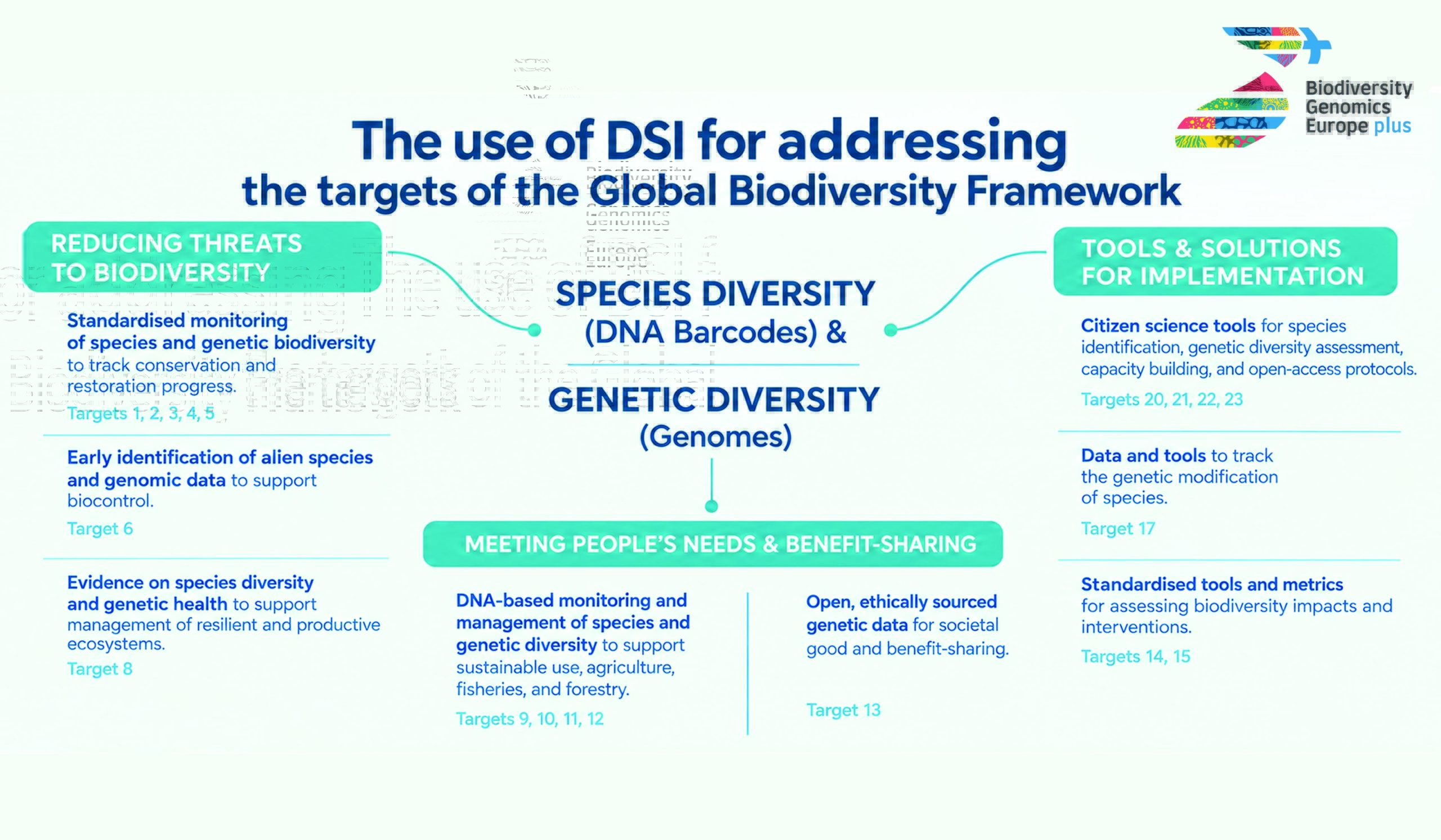
DSI – especially DNA sequence data – represents a powerful tool for understanding the natural world and for addressing the KMGBF targets. Key areas where DSI can enable delivery of the targets include measuring genetic diversity to safeguard species; speeding up biomonitoring; and meeting societal needs from nature.
Click on the image below for a closer look.
Five crucial areas for improvement
Alas, the potential of DSI to meet the KMGBF targets is, in itself, not enough.
BGE+ understands that further progress is needed to support the full realisation of these benefits from DSI. Accessibility to technology, Capacity building, Quality control of data, Standardisation, and Data Interoperability are five key areas where there is more work to do.
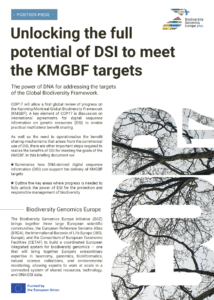
To summarise these ideas we have crafted a position paper that we will bring with us to COP17. You can read it by clicking on the image below.
Come visit us at COP17
For those interested in knowing more about BGE+ and the crucial value of DSI for addressing the KMGBF targets, our colleague Dr. Camila Mazzoni (Leibniz Institute for Zoo and Wildlife Research) will be available on Wednesday, 21st October, from 14:00h – 15:00h (AMT, UTC+4) at the EU Science for Biodiversity booth, at the Blue Zone