Supporting the whole-genome research community through ERGA
Producing a reference genome, a detailed map of a species’ DNA, can take years of fieldwork, laboratory experiments, and computer analysis. Its value also depends on what happens afterwards. Researchers need shared standards to assess data quality, places to exchange expertise, and the means to apply genomic information to questions in conservation, agriculture, and ecosystem management. BGE+ will support this wider research community through the European Reference Genome Atlas (ERGA).
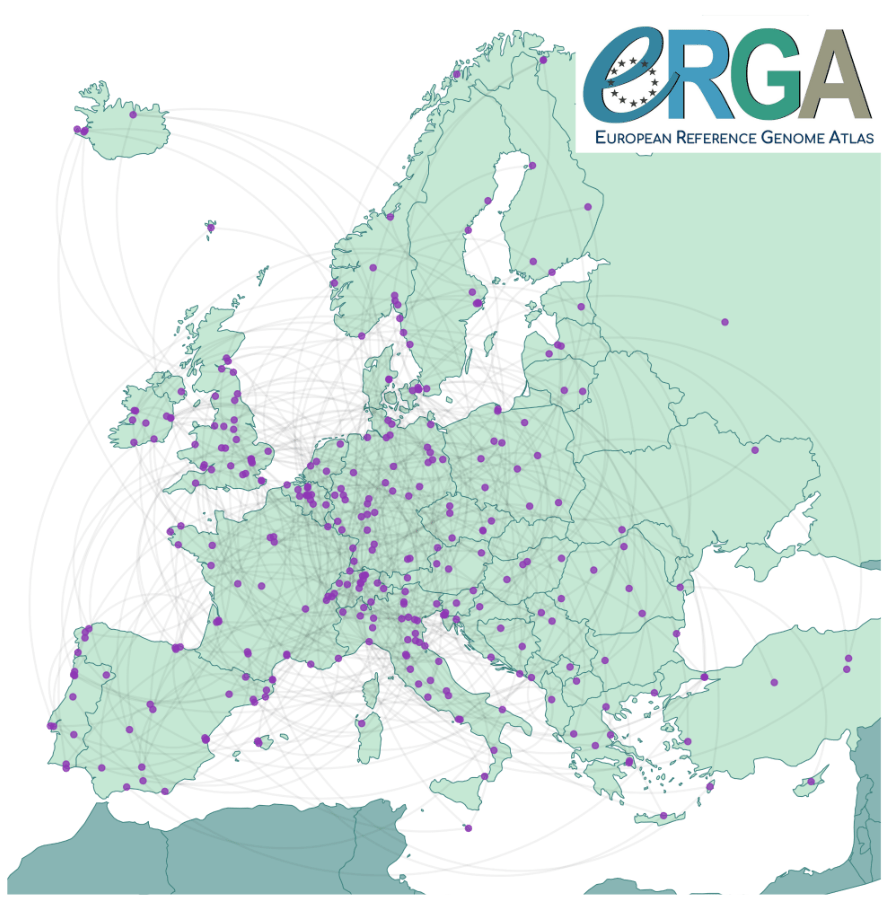
The ERGA network across Europe. Purple dots mark the cities of members’ primary affiliations.
ERGA connects researchers and institutions working on Europe’s eukaryotic genomes and genomic data, from animals and plants to fungi and other organisms. Building on the work of Biodiversity Genomics Europe, BGE+ and ERGA will help coordinate this community across 39 member countries. It will support the development of new genome projects, maintain a community-led system for reviewing genome quality, and improve access to guidance, training, and shared workflows. A network of BioGenome Hubs will bring together sequencing facilities with expertise in field sampling and laboratory work, while a parallel applications network will focus on the analysis and use of whole-genome data.
This work is intended to make participation in biodiversity genomics more accessible and its results more consistent and reusable. It will facilitate the circulation of knowledge and methods across Europe by connecting research teams, technical facilities, and potential users of genomic data. Over time, these links may allow more researchers to produce reliable genome resources and help conservation practitioners and other sectors assess how genomic information can contribute to biodiversity monitoring and management. The work also connects BGE+ with the wider Earth BioGenome Project, placing Europe’s efforts within a global programme to document eukaryotic biodiversity through genomics.